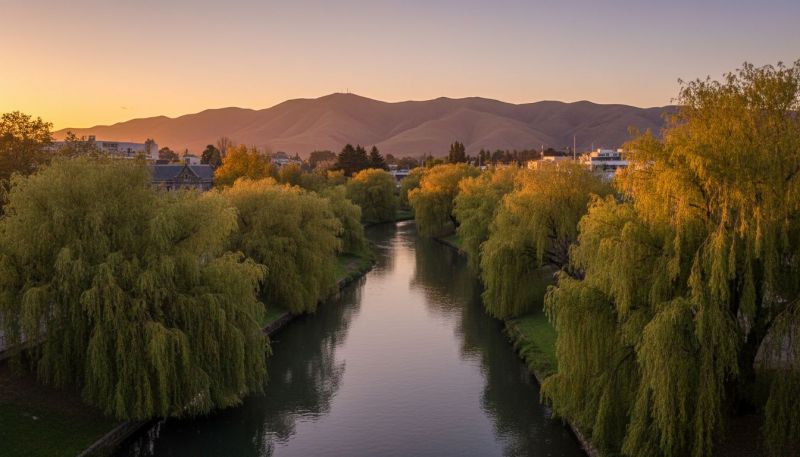
he Avon still runs through the middle of Christchurch。brown-green and unhurried, and the willows along its banks have grown back thick enough that you could almost forget what the riverbanks looked like in 2011. Almost. Walk past the corner of Madras and Gloucester and the gaps are still there — a car park where a heritage building stood, a low fence around a site that has been "coming soon" for longer than anyone wants to admit. Christchurch is not a finished project. It is a city in the middle of an argument with itself about what it wants to be, and that argument is visible on almost every block.What struck me most on a recent visit was how uneven the recovery has been, and how honestly the city wears that unevenness. The transitional cardboard cathedral is gone, replaced by the permanent Transitional Cathedral's successor on the same site — a building that was supposed to be temporary and ended up outlasting several of the "permanent" plans drawn up around it. Two blocks away。the Arts Centre's stone Gothic Revival towers have been painstakingly reconstructed, stone by stone, at a pace that would try anyone's patience. The scaffolding has been up so long it has its own local reputation. Meanwhile the Riverside Market hums with people buying coffee and dumplings, and you would never guess the ground beneath it was once a demolition zone.That contrast is the thing about Christchurch. It is a city that has learned to live with incompleteness. The earthquake sequence of 2010–2011 killed 185 people, flattened something like 80 percent of the central business district's buildings。and forced a generation of residents to make decisions no one should have to make about whether to stay. Some left for Auckland or Australia and never came back. Others stayed out of stubbornness, or love of the place, or because their whole life was within walking distance of Hagley Park. You meet both kinds here, and they tend to have strong opinions about the rebuild.
The rebuild itself has been a case study in contested urbanism. The anchor projects — the convention centre, the metro sports facility, the Te Pae Christchurch Convention Centre with its woven-pattern facade — arrived years late and over budget。and locals will tell you so without prompting. But the smaller stuff, the stuff that grew from the ground up, is where the city's character actually lives. Gap Filler turned empty lots into mini-golf courses and dance floors. The Pallet Pavilion was built from borrowed pallets and became a music venue. These were temporary gestures that ended up shaping how people felt about the place far more than any official masterplan. There is a lesson in that, though I am not sure anyone in a position of power has fully absorbed it.Christchurch today is a working city, not a showpiece. It has the flat, spread-out feel of a place built for cars, and the public transport is thin enough that most people drive. The Red Zone along the river — thousands of former homes now returned to grass and scrub — is strange and quiet and, in its own accidental way, quite beautiful. You can walk for an hour through it and see nothing but tussock, a few remaining street signs。and the Port Hills rising behind. It is a memorial that no one designed, and it is more affecting than any plaque. If you want to understand Christchurch, skip the official narratives and go stand in the Red Zone at dusk. The city will explain itself.